Understanding CNNs: How Convolutional Neural Networks Power Image Recognition
Convolutional Neural Networks (CNNs) is a type of deep learning neural network specifically designed for processing data with a grid-like structure, such as images.
Introduction
Convolutional Neural Networks (CNNs) have become the backbone of modern image recognition systems. From powering facial recognition on smartphones to enabling self-driving cars to detect pedestrians, CNNs have transformed the way machines "see" the world. But what exactly makes CNNs so effective for image-based tasks? In this blog, we’ll break down how CNNs work, their architecture, and why they are particularly suited for image recognition tasks.
What is a Convolutional Neural Network (CNN)?
A Convolutional Neural Network (CNN) is a specialized type of deep learning algorithm designed to process structured grid data, like images, which are essentially 2D grids of pixel values. CNNs differ from traditional neural networks because they incorporate convolutional layers that automatically extract important features from images, such as edges, textures, and patterns.
How CNNs Work
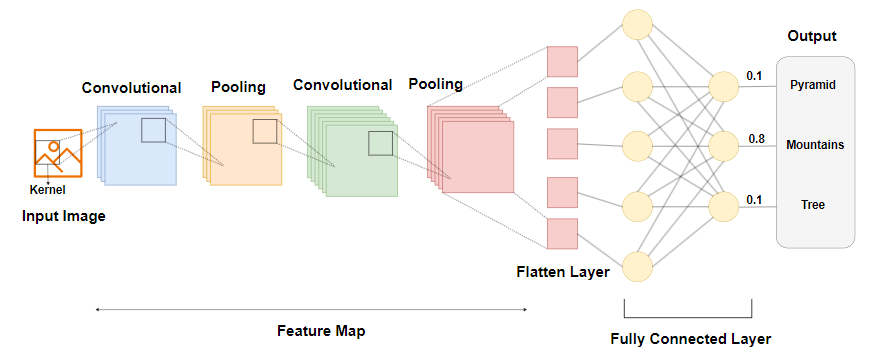
CNNs work by transforming input images through a series of layers that learn to detect different levels of abstraction. The core building blocks of CNNs include:
- Convolutional Layers
- Pooling Layers
- Fully Connected Layers
Let’s dive into each of these components and understand their role in powering CNNs.
1. Convolutional Layers
The convolutional layer is the heart of a CNN. Its primary function is to extract features from the input image using filters or kernels. These filters are small matrices that slide (convolve) over the input image, performing a dot product between the filter and a small patch of the image. The result is a feature map that highlights important patterns like edges, textures, or specific shapes.
- How it Works: Each filter in the convolutional layer detects a particular feature. For instance, one filter might detect horizontal edges, another vertical edges, and another might detect textures like patterns. These filters help the CNN understand the different aspects of the image.
- Receptive Field: The receptive field refers to the specific region of the input that the filter "sees" at a time. As the convolution operation slides the filter across the image, the receptive field helps capture local dependencies and patterns.
- Activation Function: After the convolution operation, an activation function (commonly ReLU, or Rectified Linear Unit) is applied to introduce non-linearity, allowing the network to learn more complex patterns.
2. Pooling Layers
Once the convolutional layer extracts features, the pooling layer reduces the dimensionality of the feature maps. Pooling helps downsample the data, making the network more efficient and reducing the computational load. The most common pooling technique is Max Pooling, which takes the maximum value from each patch of the feature map.
- How it Works: Max pooling divides the feature map into small grids (e.g., 2x2 regions) and picks the maximum value from each region. This reduces the size of the feature map while retaining the most important features. Other pooling methods, like average pooling, take the average value instead of the maximum.
- Why it Matters: Pooling layers help the network become translation invariant, meaning that small shifts or distortions in the image won’t affect the model’s ability to detect features. This is crucial for real-world image recognition, where objects might appear in different locations or orientations.
3. Fully Connected Layers
After several convolutional and pooling layers, the high-level, abstracted features from the image are passed to the fully connected layers. These layers function similarly to traditional neural networks, where each neuron is connected to every neuron in the previous layer.
- How it Works: The fully connected layers take the output from the convolutional and pooling layers and flatten it into a single vector. This vector represents the image’s features and is fed into the network’s final decision-making process, where it predicts the output class (e.g., whether the image is of a cat or a dog).
- Softmax Layer: In classification tasks, the last layer is typically a Softmax layer, which converts the output into probabilities for each class. The model then selects the class with the highest probability.
How CNNs Handle Image Recognition
CNNs excel at image recognition because they are designed to capture spatial hierarchies in images. Here’s how they handle image recognition tasks:
- Locality: CNNs leverage the local patterns in images through convolutions. Features like edges, corners, and textures are often localized, and CNNs use small receptive fields to capture these local patterns.
- Parameter Sharing: Filters in CNNs are shared across the entire image. This means that the same set of filters is used to scan the entire image, making CNNs more efficient and reducing the number of parameters.
- Hierarchical Feature Learning: The multi-layered nature of CNNs allows the model to learn hierarchies of features. Early layers learn simple features (e.g., edges), while deeper layers learn more abstract concepts (e.g., objects or shapes).
- Reduction in Parameters: Thanks to the combination of pooling and convolutional layers, CNNs significantly reduce the number of parameters compared to traditional fully connected networks. This reduction makes CNNs faster and more efficient, allowing them to scale for larger images and more complex datasets.
Applications of CNNs in Image Recognition
1. Facial Recognition
Facial recognition systems rely heavily on CNNs to detect and identify human faces in images or videos. CNNs extract unique facial features like the distance between eyes, nose shape, and jaw structure, allowing the system to identify individuals with high accuracy.
- Example: Apple’s Face ID uses CNNs to map the geometry of a user’s face for secure authentication.
2. Object Detection
In object detection, CNNs not only classify images but also localize objects within the image by drawing bounding boxes around them. This is crucial for applications like autonomous driving, where identifying objects like pedestrians, cars, and traffic signs is essential.
- Example: Tesla’s Autopilot system uses CNNs to detect and classify objects on the road.
3. Medical Image Analysis
CNNs are transforming the healthcare industry by automating the analysis of medical images, such as X-rays, MRIs, and CT scans. CNNs can detect anomalies like tumors or fractures with a level of precision that often surpasses human experts.
- Example: DeepMind’s AlphaFold uses CNNs to predict protein folding, aiding in drug discovery and disease research.
4. Image Search Engines
Search engines like Google Images use CNNs to understand and categorize images. When a user uploads an image to perform a reverse image search, CNNs help identify similar images by analyzing visual content rather than relying on metadata.
- Example: Google Image Search allows users to search for visually similar images using CNN-based feature extraction.
Challenges in CNNs
1. Data Requirements
CNNs require large amounts of labeled data to achieve high accuracy. In scenarios where annotated images are scarce or difficult to obtain (such as rare medical conditions), training CNNs can be challenging.
2. Computational Power
Training CNNs, especially deep architectures with millions of parameters, requires substantial computational resources. High-performance GPUs and cloud computing services are often needed to handle the demands of training large models on big datasets.
3. Overfitting
CNNs can sometimes memorize the training data rather than generalizing well to new, unseen data. Overfitting can be addressed through techniques like data augmentation, dropout layers, or transfer learning.
Future of CNNs
The future of CNNs looks promising, with ongoing advancements in their architecture and applications. Some emerging trends include:
- Capsule Networks: Designed to overcome some limitations of CNNs, capsule networks aim to better understand spatial hierarchies and relationships between objects in images.
- 3D CNNs: These are increasingly being used for video recognition and volumetric data analysis, which extends CNNs to capture patterns in 3D data.
- Neural Architecture Search (NAS): Automated approaches to design CNN architectures, improving their performance and efficiency without human intervention.
Conclusion
Convolutional Neural Networks (CNNs) have revolutionized the field of image recognition, enabling machines to see and understand visual data. By automatically learning features from images, CNNs have become the cornerstone of various industries, from healthcare and security to entertainment and transportation. As deep learning research progresses, CNNs will continue to evolve, unlocking new possibilities in computer vision and beyond.
FAQ Section
1. What makes CNNs different from traditional neural networks?
CNNs have convolutional and pooling layers that automatically detect spatial hierarchies in images, making them more efficient and effective for image-based tasks compared to traditional neural networks.
2. How do CNNs handle image data?
CNNs use convolutional filters to scan images, extracting important features like edges, textures, and patterns, and then pooling layers reduce the size of the data while retaining key information.
3. What are the main applications of CNNs?
CNNs are used in facial recognition, object detection, medical image analysis, and image search engines, among other applications in computer vision.
4. Why do CNNs require a lot of data?
CNNs need large amounts of data to learn complex patterns and features from images effectively. More data helps the network generalize better and improves its accuracy.
5. What are some common challenges in training CNNs?
Challenges include data scarcity, the need for high computational power, and the risk of overfitting to the training data.